
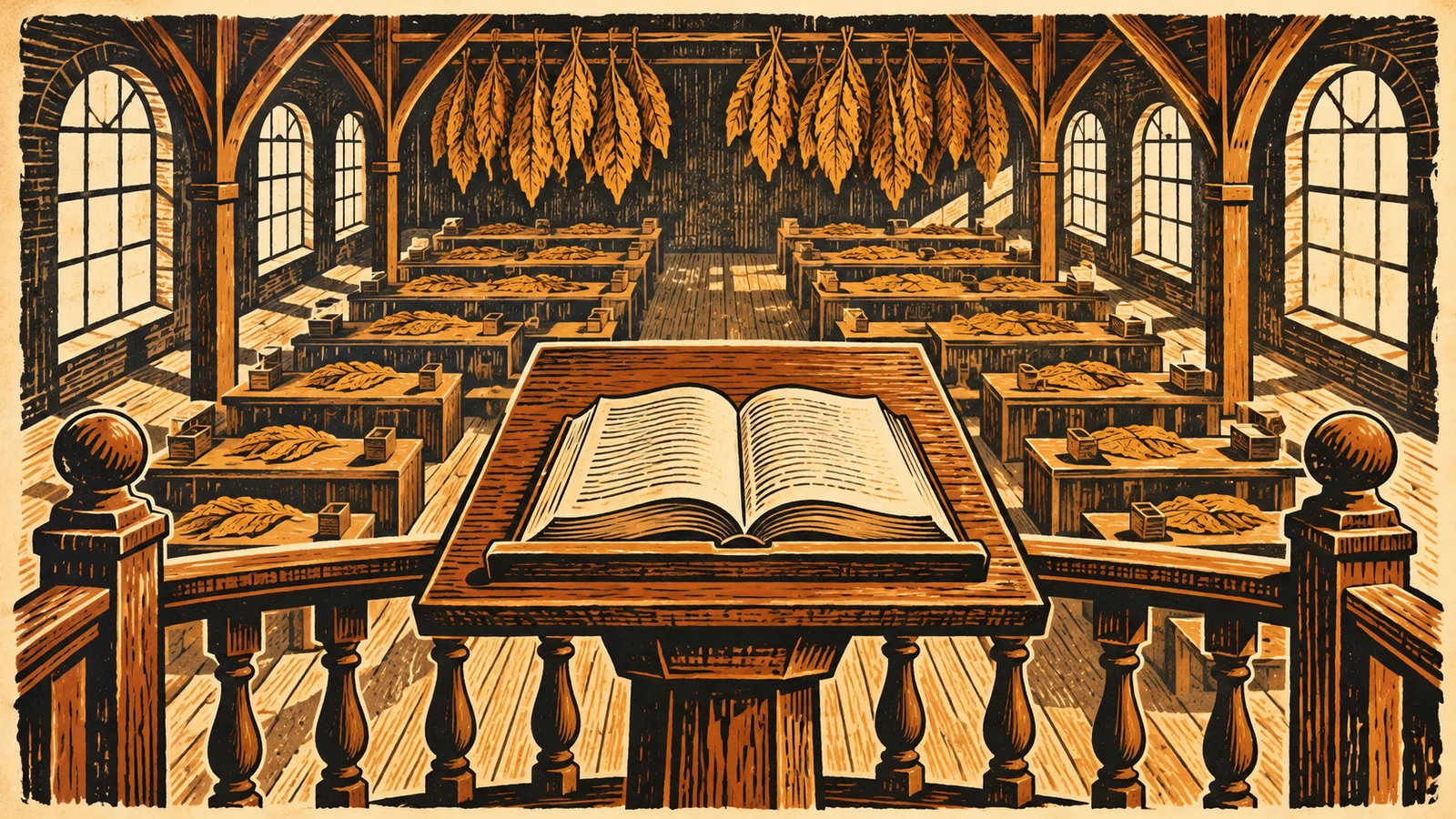
A cigar factory once had a job you could do without touching tobacco. You read aloud.
The Spanish word is lector, meaning reader. A surviving Tampa photograph puts that job inside an ordinary working room. Rows of workers sit below an elevated reader. The picture belongs to the Library of Congress's National Child Labor Committee collection. Its catalog dates it to January 1909 and attributes it to Lewis Hine.
The caption supplies the detail that changes how you read the scene. Workers paid the reader and selected his material. Books and newspapers accompanied the work. The Library of Congress record preserves that description.
Pause on the payment. Someone sitting at a rolling bench contributed toward the voice above it. The reading was something workers chose to support.
Start with the people below the platform
Cigar history can become a parade of founders. A factory opens, a brand appears, a familiar surname fills another box. The reader shifts your attention toward the people making those cigars.
Their choices raise questions a founder's biography cannot answer. Which newspaper reached the room? Who selected the next book? Could a worker object to the selection? The photograph cannot settle those questions. They deserve to remain questions until another document supplies an answer.
The National Park Service describes workers hiring readers for entertainment in Ybor City's factories. Its account also connects newspaper reading with information about Cuba's political situation. Those are different uses of the same voice. A reading could carry a story or news about events beyond the factory. The NPS district history supplies that context.
Avoid imagining a single script repeated across every room. The evidence here concerns particular records and a particular place. It cannot establish what every cigar worker heard, believed, or enjoyed.
That boundary makes the story easier to follow. You have a photographed room, a dated catalog, and a description of worker payment. You can build from those details without inventing a conversation between the benches.
Read the caption as carefully as the picture
An old photograph can feel like direct access to a vanished afternoon. The accompanying words deserve the same scrutiny as the visible scene.
Hine's caption makes a broad statement about workers' education. Treat that statement as the photographer's assessment. The image cannot reveal each person's schooling or reading ability. Repeating the caption as a universal fact would erase that distinction.
A useful reading has two parts. Describe what the image shows, then identify what the catalog says. Keep your own interpretation in a separate sentence.
For example, the elevated position suggests the room was arranged around an audible reader. That is an interpretation of the arrangement. Worker payment comes from the caption. Mixing those statements would give both the same apparent certainty.
The same discipline helps with a factory tour. A guide might point toward a platform or an old lectern. Ask which document connects that object with a reader. A dated photograph can answer something a polished anecdote leaves open.
Bring better questions to a factory story
You can use the reader as a starting point without turning every conversation into an examination. Pick one question that fits the person telling the story.
Ask whether the account comes from a worker's recollection or a company record. Both can contribute. Each starts from a different position inside the factory.
If someone names a novel, ask where that particular title appears in the record. A famous book makes an attractive detail. Its appeal does not identify which room heard it.
Dates also help. A practice documented in one decade may have changed in another. Keep the date attached when you repeat the story later.
The Breaking Cigars blog approaches the trade through individual people. Reading factory history asks for similar attention to the person speaking. A roller's account and a visitor's description should retain their different voices.
Our editorial recommendation is simple: collect the source beside the anecdote. A short note can hold the factory name, date, document, and unresolved question. You will remember which detail needs checking before sharing it.
A reading session without the costume
For a lounge owner, this history suggests a modest cultural event. Choose a short historical text and discuss it with interested adult guests. Present the event as a modern reading group inspired by factory history.
There is no need to claim you have recreated a rolling room. Invite participants to choose the next text. Credit its author and explain when it was written. Check permission before reproducing or publicly performing copyrighted material.
Keep the source available beside the reading. Someone might want the whole document after hearing one paragraph. Give them the archive link and the catalog title.
The cigar guide covers the physical object and its basic vocabulary. A reader's photograph opens another route into the trade. Start with the catalog entry, enlarge the image, and look at the workers below the platform.